From a post in Tsikot by Autohistorian (post no. 36) -
Leonardo Sarao was an enterprising cochero (calesa driver) who found work in an automotive bodybuilding and repair shop. The first Sarao Motors jeepney rolled out in 1953. Anastacio Francisco was a calesa painter who was later employed by Sarao, and who struck out on his own to found Francisco Motors. The earliest passenger jeepney is said to have been conceived, built, and driven in 1945 by Clodualdo Delfino, a musician-entertainer who needed to make a living immediately after liberation.
"Last October [2000], when Leonardo Sarao broke the news to his staff of almost 300 that Sarao Motors – once the biggest jeepney-makers in the Philippines – was ceasing production, most broke down in tears.
"It is probably the hardest speech 78-year-old Sarao has ever had to make. But he had no other viable choice as the 47-year-old transportation company had been bleeding since 1995, mainly, he says, due to changed government regulations. "Our sales of jeepney units plunged because the Land Transportation Office (LTO) cancelled the issuance of franchises to jeepney lines, but let other public transportation vehicles such as taxicabs continue to get theirs," says the hoarse-voiced founder of Sarao Motors."
Sarao Motors
This business is one of a kind so far. Sarao has made history together with the progress of Las Piñas being a producer of the primary form of transportation, jeepneys. This company is one of the large contributors to the high economy that we are experiencing. They contributed so much because of the unique and eye catcher designs that draws everyone's attention. If a Las Piñero is asked about jeepneys he would probably mention Sarao: major producer of jeepneys in Las Piñas.
The business is known in the whole world for its competency rate and their progress rate. It also has a big role to the introduction of urbanization, specially in transportation, to our city. It also served as a start of the business in Las Piñas and inspired the uprising shops to excel in their shops and stores.
The company also uses top certified, quality Filipino products and materials having a 100% pinoy product and by doing this it supports the other businesses together in improving his vehicles. In this we can see the give and take relationship between the competing businesses in Las Piñas. Certainly, Sarao motors identified Las Piñas as a industrialized and progressive city.
Showing posts with label PhUV. Show all posts
Showing posts with label PhUV. Show all posts
Sunday, September 23, 2007


Saturday, September 22, 2007
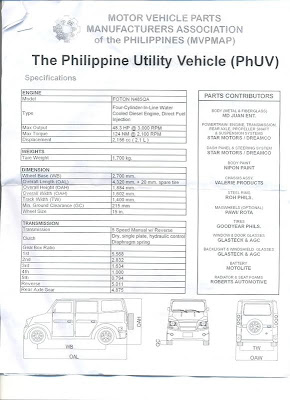
MVPMAP PhUV
This vehicle is the product of a consortium of members of the Motor Vehicle Parts and Manufacturers Association of the Philippines (MVPMAP). It was unveiled June 12, 2007 at the Market!Market! mall with no less than President Arroyo in attendance.




Tuesday, September 11, 2007
AMC Hammer
Photos from Pbase account of Otep Rivera


Source: 01 July 2003 review by mbt as posted in Tsikot
AMC Hammer
Power, prestige, and style without the premium price tag.
by: Otep Rivera
In a posh village along Katipunan Avenue, a passing Ford Expedition stops beside the yellow AMC Hammer we are sitting in. The Expedition’s impressed driver rolls down his window and asks, “Is that for real?” We merely smile.
Those four words could well be the best compliment you can give to the AMC Hammer. It looks so close to the real-deal (and five times more expensive) AM General Hummer that most people can’t even tell which is which by simply eyeballing the exterior. That can’t be said of the other locally-manufactured Hummer replicas whose quality and proportions are truly comical even when compared to the locally-produced AMC Hammer.
Alana Motors Corporation has been in the vehicle assembly business for three generations now. They manufacture everything from Mini Cruisers to AUV’s. And now, the latest addition to their product line up is the Hammer. AMC may be a cottage industry manufacturer but they are a premium cottage industry manufacturer in the tradition of those small sports car firms in Europe.
An AMC Hammer is not a mish-mash of various parts from different manufacturers. Almost all Hammers are built on a Nissan Patrol chassis, including the frame, suspension, brakes, and other components, using the proper Nissan Patrol drivetrain (engine, transmission, transfer case) for that chassis. Leaf-sprung models use the SD33 3.3L inline-six turbodiesel engine while the more expensive coil-sprung models use the TD42 4.2L normally-aspirated inline-six engine. Most of the donor drivetrains and chassis come from ex-JDM (Japanese Domestic Market) Patrols but you can provide your own donor drivetrain and chassis (as long as they match) to AMC and they will build a Hammer around it.
Externally, the Hammer shares almost every styling element with the Hummer. Everything seems to have been designed by someone with only a ruler and a pencil to work with. Everything looks and feels robust. The doors slam with authority and don’t rattle on the road. The engine cover (which tilts forward just like in the authentic Hummer) is heavy and substantial (the steel grille on the engine cover does lift up for routine maintenance). The tow loops on the engine cover, although not rated by AMC, are mounted directly to the chassis frame rails and are more than cosmetic add-ons. They will take some load if the huge front and rear tow loops are still not enough. Unlike the Hummer which uses fiberglass on some key components, the Hammer is all steel (gauge 18 and 21). Other visual clues that what you are looking at is a Hammer are the six-slot grille (instead of the trademark seven), generic marker lamps and Ssangyong Korando taillamps. The Hammer is also a bit narrower (by around 8 inches) than the Hummer, but you would never know that unless you took a tape measure to both.
The TD42 engine of the Hammer we tested is rated at a measly 115hp at 4,000 rpm. A Honda Civic has more power than that. Unlike the Honda, however, the Hammer’s engine will have all of its 195 lb-ft (264 Nm) of torque available at just 2,000 rpm. This thing will pull like a freight train from a standing start and will let you keep up with traffic easily. This engine is more akin to a Mack truck’s than to your average AUV or pickup truck. It has two oil filters, a timing chain system, and a water separator for the fuel system. And just like in the original Hummer, this engine draws air via a snorkel at the base of the windshield. AMC upgrades this engine with a larger-capacity five-row radiator and an additional electric cooling fan to cope with the increased loads and harsher conditions Hammers are designed to withstand.
Steering is via a recirculating-ball system with standard power assist which provides decent feel. Its seven turns lock-to-lock is slow (perhaps a touch too slow for paved roads) and is perfect for trail work. The standard five-speed manual transmission (a four-speed automatic is optional) drives decently enough but can become balky and stubborn during gearchanges. Part of the blame could be the fabricated linkages AMC uses. Running changes are being done at the factory regarding this matter. The Hammer uses four wheel ventilated disc brakes on all four wheels with no ABS or other electronic assistance. It does a pretty admirable job of stopping the two-ton beast even from extralegal speeds. Pedal feel is good enough and there is not much fade even after repeated stops.
The Hammer uses solid axles suspended by coil springs on both ends. The rigid front axle is located by three links and the rear, by five links. Stabilizer bars are standard equipment. The settings are quite soft allowing for a good deal of body roll when the Hammer is driven hard. But then again, the Hammer is no Miata and the soft calibration really helps give it a good ride both on and off pavement. Standard tires are 33X12.5R15’s mounted on painted steel rims. However, 35X12.5R15 tires on chrome rims are the most popular option. 38” tires can also be fitted (these are even larger than the Hummer’s standard 37” tires).
Inside, a huge center console neatly splits the interior into four distinct compartments, as in the genuine Hummer. Each compartment sports a single captain’s chair, which means that the total passenger capacity is just four. A miraculous-capacity CR-V the Hammer is not, although an optional rear bench seat is available in case you want to bring four friends along for a drive. The dashboard and center console are constructed out of metal and is painted in a low gloss finish, giving them a tough, business-like look. The door panels are finished in vinyl and cloth and have a quality feel to them. The fuzzy carpeting used on the floors and ceilings are even better looking than the ‘mouse fur’ upholstery used on most modern cars today. There are separate air-conditioning ducts for rear passengers, and all seats are fitted with three-point ELR safety belts as standard equipment as well as map lamps and grab handles. The plastics are still not up to Japanese-level but they look good enough. The interior of the Hammer can be customized to the owner’s desires (and budget) but the standard interior is not quite bare. About the only things missing are a sound system and power windows (both are options).
Driving the Hammer takes some getting used to. The sheer size of the machine will limit where you can go and where you can park. But this handicap is not exclusive to the Hammer and you will get over it after some time. What you will really need some getting used to is the instant celebrity status you acquire while behind the wheel of this behemoth. Be prepared for the stares, waves, and thumbs-up from complete strangers as you drive by. Even the police will give you preferential treatment if you are in a Hammer.
Off-road is where the Hammer really shines. The Nissan Patrol four-wheel drive system uses a hybrid front hub lock system which can be shifted on-the-fly or manually locked (using the tire wrench) for extended four-wheeling. The approach and departure angles are superb and the ground clearance is more than adequate for anything you can throw at it. And just as in the Patrol, the transmission and engine are located high up between the frame rails for protection. The 95-liter fuel tank is also located high and is protected by a dedicated steel skidplate. The Hammer does not have locking differentials (there are aftermarket ones available) on both ends but the aggressive mud tires usually have enough traction for the job. An optional matte-paint finish (think spray on bedliner) ensures that your Hammer will never get scratched while you enjoy it on the trail.
Prices for the Hammer start at P648,000.00 for a leaf-sprung pickup model with an SD33 engine, to P788,000.00 for a wagon using a coil-sprung chassis with a TD42 engine. Various options (roof racks, roof lamps, fancy sound systems, etc.) can easily inflate the price, but you will still never go near the P5 million price tag of the Hummer.
If you’re the extroverted type of person who loves the outdoors and enjoys big toys, the AMC Hammer is for you. Granted that the vehicle still has some minor flaws to be worked out, three generations of vehicle assembly has really done the Alana family a lot of good in terms of the final product. This is the best locally-assembled Hummer replica to date. Just ask the Expedition driver.


Source: 01 July 2003 review by mbt as posted in Tsikot
AMC Hammer
Power, prestige, and style without the premium price tag.
by: Otep Rivera
In a posh village along Katipunan Avenue, a passing Ford Expedition stops beside the yellow AMC Hammer we are sitting in. The Expedition’s impressed driver rolls down his window and asks, “Is that for real?” We merely smile.
Those four words could well be the best compliment you can give to the AMC Hammer. It looks so close to the real-deal (and five times more expensive) AM General Hummer that most people can’t even tell which is which by simply eyeballing the exterior. That can’t be said of the other locally-manufactured Hummer replicas whose quality and proportions are truly comical even when compared to the locally-produced AMC Hammer.
Alana Motors Corporation has been in the vehicle assembly business for three generations now. They manufacture everything from Mini Cruisers to AUV’s. And now, the latest addition to their product line up is the Hammer. AMC may be a cottage industry manufacturer but they are a premium cottage industry manufacturer in the tradition of those small sports car firms in Europe.
An AMC Hammer is not a mish-mash of various parts from different manufacturers. Almost all Hammers are built on a Nissan Patrol chassis, including the frame, suspension, brakes, and other components, using the proper Nissan Patrol drivetrain (engine, transmission, transfer case) for that chassis. Leaf-sprung models use the SD33 3.3L inline-six turbodiesel engine while the more expensive coil-sprung models use the TD42 4.2L normally-aspirated inline-six engine. Most of the donor drivetrains and chassis come from ex-JDM (Japanese Domestic Market) Patrols but you can provide your own donor drivetrain and chassis (as long as they match) to AMC and they will build a Hammer around it.
Externally, the Hammer shares almost every styling element with the Hummer. Everything seems to have been designed by someone with only a ruler and a pencil to work with. Everything looks and feels robust. The doors slam with authority and don’t rattle on the road. The engine cover (which tilts forward just like in the authentic Hummer) is heavy and substantial (the steel grille on the engine cover does lift up for routine maintenance). The tow loops on the engine cover, although not rated by AMC, are mounted directly to the chassis frame rails and are more than cosmetic add-ons. They will take some load if the huge front and rear tow loops are still not enough. Unlike the Hummer which uses fiberglass on some key components, the Hammer is all steel (gauge 18 and 21). Other visual clues that what you are looking at is a Hammer are the six-slot grille (instead of the trademark seven), generic marker lamps and Ssangyong Korando taillamps. The Hammer is also a bit narrower (by around 8 inches) than the Hummer, but you would never know that unless you took a tape measure to both.
The TD42 engine of the Hammer we tested is rated at a measly 115hp at 4,000 rpm. A Honda Civic has more power than that. Unlike the Honda, however, the Hammer’s engine will have all of its 195 lb-ft (264 Nm) of torque available at just 2,000 rpm. This thing will pull like a freight train from a standing start and will let you keep up with traffic easily. This engine is more akin to a Mack truck’s than to your average AUV or pickup truck. It has two oil filters, a timing chain system, and a water separator for the fuel system. And just like in the original Hummer, this engine draws air via a snorkel at the base of the windshield. AMC upgrades this engine with a larger-capacity five-row radiator and an additional electric cooling fan to cope with the increased loads and harsher conditions Hammers are designed to withstand.
Steering is via a recirculating-ball system with standard power assist which provides decent feel. Its seven turns lock-to-lock is slow (perhaps a touch too slow for paved roads) and is perfect for trail work. The standard five-speed manual transmission (a four-speed automatic is optional) drives decently enough but can become balky and stubborn during gearchanges. Part of the blame could be the fabricated linkages AMC uses. Running changes are being done at the factory regarding this matter. The Hammer uses four wheel ventilated disc brakes on all four wheels with no ABS or other electronic assistance. It does a pretty admirable job of stopping the two-ton beast even from extralegal speeds. Pedal feel is good enough and there is not much fade even after repeated stops.
The Hammer uses solid axles suspended by coil springs on both ends. The rigid front axle is located by three links and the rear, by five links. Stabilizer bars are standard equipment. The settings are quite soft allowing for a good deal of body roll when the Hammer is driven hard. But then again, the Hammer is no Miata and the soft calibration really helps give it a good ride both on and off pavement. Standard tires are 33X12.5R15’s mounted on painted steel rims. However, 35X12.5R15 tires on chrome rims are the most popular option. 38” tires can also be fitted (these are even larger than the Hummer’s standard 37” tires).
Inside, a huge center console neatly splits the interior into four distinct compartments, as in the genuine Hummer. Each compartment sports a single captain’s chair, which means that the total passenger capacity is just four. A miraculous-capacity CR-V the Hammer is not, although an optional rear bench seat is available in case you want to bring four friends along for a drive. The dashboard and center console are constructed out of metal and is painted in a low gloss finish, giving them a tough, business-like look. The door panels are finished in vinyl and cloth and have a quality feel to them. The fuzzy carpeting used on the floors and ceilings are even better looking than the ‘mouse fur’ upholstery used on most modern cars today. There are separate air-conditioning ducts for rear passengers, and all seats are fitted with three-point ELR safety belts as standard equipment as well as map lamps and grab handles. The plastics are still not up to Japanese-level but they look good enough. The interior of the Hammer can be customized to the owner’s desires (and budget) but the standard interior is not quite bare. About the only things missing are a sound system and power windows (both are options).
Driving the Hammer takes some getting used to. The sheer size of the machine will limit where you can go and where you can park. But this handicap is not exclusive to the Hammer and you will get over it after some time. What you will really need some getting used to is the instant celebrity status you acquire while behind the wheel of this behemoth. Be prepared for the stares, waves, and thumbs-up from complete strangers as you drive by. Even the police will give you preferential treatment if you are in a Hammer.
Off-road is where the Hammer really shines. The Nissan Patrol four-wheel drive system uses a hybrid front hub lock system which can be shifted on-the-fly or manually locked (using the tire wrench) for extended four-wheeling. The approach and departure angles are superb and the ground clearance is more than adequate for anything you can throw at it. And just as in the Patrol, the transmission and engine are located high up between the frame rails for protection. The 95-liter fuel tank is also located high and is protected by a dedicated steel skidplate. The Hammer does not have locking differentials (there are aftermarket ones available) on both ends but the aggressive mud tires usually have enough traction for the job. An optional matte-paint finish (think spray on bedliner) ensures that your Hammer will never get scratched while you enjoy it on the trail.
Prices for the Hammer start at P648,000.00 for a leaf-sprung pickup model with an SD33 engine, to P788,000.00 for a wagon using a coil-sprung chassis with a TD42 engine. Various options (roof racks, roof lamps, fancy sound systems, etc.) can easily inflate the price, but you will still never go near the P5 million price tag of the Hummer.
If you’re the extroverted type of person who loves the outdoors and enjoys big toys, the AMC Hammer is for you. Granted that the vehicle still has some minor flaws to be worked out, three generations of vehicle assembly has really done the Alana family a lot of good in terms of the final product. This is the best locally-assembled Hummer replica to date. Just ask the Expedition driver.
DPROX Chokaran


Source: Disenyo Pilpino
The DPROX Chokaran® is Disenyo Pilipino 's attempt to prove that a vehicle can be conceptualized, designed, fabricated and assembled by Filipinos, given existing technologies and prevailing economic conditions.
The Chokaran is a four-wheel-drive vehicle adapted to Philippine driving conditions. It was designed for the use of the average Filipino family, and is also called "Family Utility Vehicle" or FUV ®.
Wagon, Shuttle, and 2WD versions may be requested.
The main design criteria are:
1. SMOOTHNESS of ride - because of perennial floods and rough road conditions; big wheels and long wheelbase;
2. DURABILITY like that of the Jeepney - a 10 to 15-year performance expectancy for economic and ecological reasons;
3. COMFORT and amenities of a car - to be at par, at least, with prevailing auto safety and interior standards;
4. USEFULNESS of a pick-up - for occasional light to medium hauling;
5. RUGGEDNESS of an off-roader - for rural as well as urban use, with 4WD option;
6. AVAILABILITY of parts and service - can be maintained and serviced anywhere in the archipelago and uses parts found in most supply stores;
7. FLEXIBILITY - convertible from, pickup to wagon to passenger;
8. FILIPINO STYLE - an evolution of the Jeepney style to connect with Filipino automotive tastes.
Chokaran and similar DPROX projects are custom assembled by prequalified jeepney/AUV fabricators using indigenous automotive fabrication methods and practices, in a sequence akin to building construction projects. The segments of the project are as follows:
1. ENGAGEMENT ~ the Owner/Customer enters into an agreement with the Project Designer;
2. PROGRAMMING & SOURCING ~ the Specifications of the project are determined, and the essential parts and components are purchased;
3. POWER TRAIN ASSEMBLY ~ the platform consisting of engine and chassis are assembled;
4. DESIGN DEVELOPMENT ~ the specifications are translated into fabrication drawings and models if necessary;
5. BODY FABRICATION & PAINTING ~ upon purchasing the needed materials and parts, the body is fabricated on the platform and painted;
6. INTERIORS & DETAILING ~ upon purchasing the needed materials and parts, the interiors, automotive glass and specified accessories are installed;
7. TESTING & REGISTRATION ~ the vehicle is road-tested and registered with the LTO;
8. DELIVERY ~ the vehicle is delivered to the Owner/Customer.
Fabrication can take anywhere from three to six months, depending on the complexity of the work required. The basic version of Chokaran is available at the price of a passenger jeepney. Prices of vehicles custom-built to owner's specifications may vary accordingly. The normal floor price of DPROX auto projects is PhP350,000. Projects exceeding PhP600,000 are not encouraged. The scaled-down 2x4 version is available at P275,000 upwards.
  | |
| GENERAL SPECIFICATIONS | |
| Overall Length | 4400 mm |
| Overall Width | 1880 mm |
| Overall Height | 1930 mm |
| Ground Clearance | 30 cm |
| Wheelbase | 3000 mm |
| Track | F=1800 mm; R=1780 mm |
| Gross Weight | 2000 kg max |
| Seating Capacity | 6 to 12 pax |
| Fuel Tank Capacity | 80 liters |
| ENGINE SPECIFICATIONS | |
| Fuel System | Diesel, 4-cycle |
| Cylinders | 4 cylinders, in-line |
| Displacement | 2.663 cc |
| Ignition Type | Direct Injection OHV, 8-Valve |
| Aspiration | Turbocharger |
| Bore X Stroke | 96 mm X 92 mm |
| Compression Ratio | 21.8 : 1 |
| Maximum Power | 73.8 kW = 99 hp @ 4000 rpm |
| Maximum Torque | 220 Nm = 162 lbft = 22.4 kg @ 2200 rpm |
| Coolant | Water |
| Main Bearings | 5 |
| Additives | Coco engine oil additive |
| Emission Test | Excellent |
| WHEELS & TIRES | |
| Wheels | 15-inch, "Tremor" |
| Tire Size | 31x10.50R15 |
| Tire Type | All Terrain, Light Truck |
| Tire Make | Pirelli "Scorpion" |
| --- | --- |
| CHASSIS & POWER TRAIN | |
| Format | 4WD; Rear-2WD |
| Engine Location | Front |
| Engine Alignment | Longitudinal |
| Front Suspension | Independent Double Wishbone w/ Torsion Bars & stabilizers |
| Rear Suspension | 4-link w/ Coil Springs, Stabilizer Bar & semi-floating Live-Axle |
| Transmission | 5-speed manual; 4L/4H/2H |
| Top Gear Ratio | 0.82 |
| Final Drive Ratio | 4.63 |
| Steering | Power Assisted Recirculating Ball |
| Brakes | Front & Rear Discs, w/ booster |
| --- | -- |
| BODYWORKS & STYLING | |
| Designer/Stylist | Disenyo Pilipino (DSFelipe,UAP) |
| Body Construction | Integral on truck |
| Materials | Sheet Metal, Fiberglass, Tubular Steel |
| LTO Classification | Double-Cab Pickup (Convertible UV) |
| Use Classification | Family Utility Vehicle ® |
| Doors | 4, Power Wdows; detachable rear panel |
| Pickup Bed | 0.96 x 1.55 x 0.64 = 0.95 cu.m. |
| Primer | Epoxy |
| Finish & Topcoat | Automotive & Polyurethane |
| Cabin Insulation | 10mm Polyethylene, 5mm Rubber, Felt |
| Dashboard Panel | <> |
| Windshield | 58 x 24 in. curved tempered glass |
| Windshield Washer | Yes |
| Wipers | Twin 16", variable speed |
| Windows | Power Windows |
| Mirrors | Power Side Mirrors, Wide Rear View |
| Security | Alarm, Keyless Entry, Remote Ignition |
| SAFETY & SECURITY | |
| Bumpers | Absorbent spring-mounted rubber |
| Headlights | Jeepney Type, Halogen Bulbs |
| Parking Lights | Fog w/ Halogen Bulbs |
| Body Shell | Ga.16 G.I., curved & folded |
| Seat Belts | Front 3 or 4-point, Rear 2-point |
| Airbags | Optional, Modular |
| Door Locks | Keyless Entry, Remote Ignition |
| COMFORT & AMENITIES | |
| Aircon | Single (Dual for Wagon & Shuttle) |
| Front Seats | Recaro-type Buckets; |
| Rear Seats | Reversible, Reclinable |
| Upholstery | US or German Leatherette |
| Speakers | 6 - doors & columns |
| OTHER FEATURES & OPTIONS: body paint, pillar mounted antenna, seatcover/fabrics, door trims, console box & shelf, mini-refrigerator, grab handles, | |
VW Sakbayan
Source: Motorcity
The Evolution of the Sakbayan: 1968-1980
Researched by Wilfred T. Ruiz
Club Historian, Volkswagen Club of the Philippines
In 1968, the Country Buggy was imported by DMG from Australia in CKD form. This left-hand drive version was assembled here. There was no "tooling" provided for the Philippines. Soon after, the simple body was replicated easily by the Filipino engineers of DMG (the local assemblers of Volkswagen Beetles Kombis and Type IIIs).
When Australia run out of Country Buggys for export to the Philippines, DMG sourced from Germany. DMG was able to get a different design & size pans (181), engines, drive trains and other non-Philippine components. The Philippine-made body was then adapted to this new components from Germany.
Again, when Germany run out of components for export to the Philippines, DMG again sourced from Brazil. They were able to get a different pan, engine, drive train and non-Philippine components. The body was adapted again to this new components from Brazil.
So, there are 3 distinct versions of these utility vehicles:
1st version - Australia-sourced
2nd version- Germany-sourced
3rd version- Brazil-sourced
The 2nd version and the 3rd version were substantially different from the 1st version, The body also had significant changes from the 1st version.
In my opinion, the terms "designed", "developed" and "adapted" can be used interchangeably in this situation.
The two later versions were really "designed" by the Filipino engineers at DMG.
Name-wise, these utility vehicles evolved from being the Country Buggy to Sakbayan 815 and finally to Sakbayan. To most Filipinos, they are all called Sakbayan.
The "Country Buggy" was first advertised in 1969 with the 1300 engine.
The "Sakbayan 815" was advertised in 1972 with the 1600 engine
The "Sakbayan" was advertised in 1973 with the 1600 engine and finally advertised in 1975 with the 1500 engine. (Note: I based the "advertising dates" on the dates appearing on my collection of magazine clippings of VW ads.)
Based on the advertisements, it could be said that the (Philippine) "Country Buggy", the "Sakbayan 815" and the "Sakbayan" were all designed for rugged country work characterized by rough farm roads, unpaved roads, as well as field work for the construction and services industries. The Philippines largest telephone company, PLDT, had at one time used a fleet of them. Even the government owned Philippine National Bank has a fleet of them.
To date, we are not certain how many Sakbayans were made. The production records of DMG were destroyed in a fire. I hope that someday, when the vehicle registration records of the Land Transportation Commission is fully computerized and made readily available to the public, I might be able to extract some data.
One thing for sure, based on the examples I have seen running or not running, the fewest is the Country Buggy, followed by the German-sourced version and comparatively most plentiful, the Brazil-sourced version.
To date, a few are in the hands of collectors. Most are grounded and parted for spare parts.
The Evolution of the Sakbayan: 1968-1980
Researched by Wilfred T. Ruiz
Club Historian, Volkswagen Club of the Philippines
In 1968, the Country Buggy was imported by DMG from Australia in CKD form. This left-hand drive version was assembled here. There was no "tooling" provided for the Philippines. Soon after, the simple body was replicated easily by the Filipino engineers of DMG (the local assemblers of Volkswagen Beetles Kombis and Type IIIs).
When Australia run out of Country Buggys for export to the Philippines, DMG sourced from Germany. DMG was able to get a different design & size pans (181), engines, drive trains and other non-Philippine components. The Philippine-made body was then adapted to this new components from Germany.
Again, when Germany run out of components for export to the Philippines, DMG again sourced from Brazil. They were able to get a different pan, engine, drive train and non-Philippine components. The body was adapted again to this new components from Brazil.
So, there are 3 distinct versions of these utility vehicles:
1st version - Australia-sourced
2nd version- Germany-sourced
3rd version- Brazil-sourced
The 2nd version and the 3rd version were substantially different from the 1st version, The body also had significant changes from the 1st version.
In my opinion, the terms "designed", "developed" and "adapted" can be used interchangeably in this situation.
The two later versions were really "designed" by the Filipino engineers at DMG.
Name-wise, these utility vehicles evolved from being the Country Buggy to Sakbayan 815 and finally to Sakbayan. To most Filipinos, they are all called Sakbayan.
The "Country Buggy" was first advertised in 1969 with the 1300 engine.
The "Sakbayan 815" was advertised in 1972 with the 1600 engine
The "Sakbayan" was advertised in 1973 with the 1600 engine and finally advertised in 1975 with the 1500 engine. (Note: I based the "advertising dates" on the dates appearing on my collection of magazine clippings of VW ads.)
Based on the advertisements, it could be said that the (Philippine) "Country Buggy", the "Sakbayan 815" and the "Sakbayan" were all designed for rugged country work characterized by rough farm roads, unpaved roads, as well as field work for the construction and services industries. The Philippines largest telephone company, PLDT, had at one time used a fleet of them. Even the government owned Philippine National Bank has a fleet of them.
To date, we are not certain how many Sakbayans were made. The production records of DMG were destroyed in a fire. I hope that someday, when the vehicle registration records of the Land Transportation Commission is fully computerized and made readily available to the public, I might be able to extract some data.
One thing for sure, based on the examples I have seen running or not running, the fewest is the Country Buggy, followed by the German-sourced version and comparatively most plentiful, the Brazil-sourced version.
To date, a few are in the hands of collectors. Most are grounded and parted for spare parts.
Tuesday, June 12, 2007
Subscribe to:
Posts (Atom)

